What geologic hazard poses a significant threat to Tokyo?
E very twenty-four hour period, at 5pm, the gentle tune of the children'due south song Yuyake Koyake chimes across the Minato area of Tokyo from a loudspeaker – one of hundreds dotted across schools and parks throughout this megacity of 37 million people.
The daily jingle does more than than signify the inflow of evening. It is a test for the system that is designed to save Tokyoites from what would be 1 of the worst natural disasters in recorded human history: an earthquake striking the centre of the most populous metropolis on World.
The terminal bully quake to striking Tokyo was in 1923. Experts estimate the next one is due roughly a century on, with an estimated 70% take chances of a magnitude-vii quake striking Tokyo before 2050. It is no longer a question of if but when the big one will come.
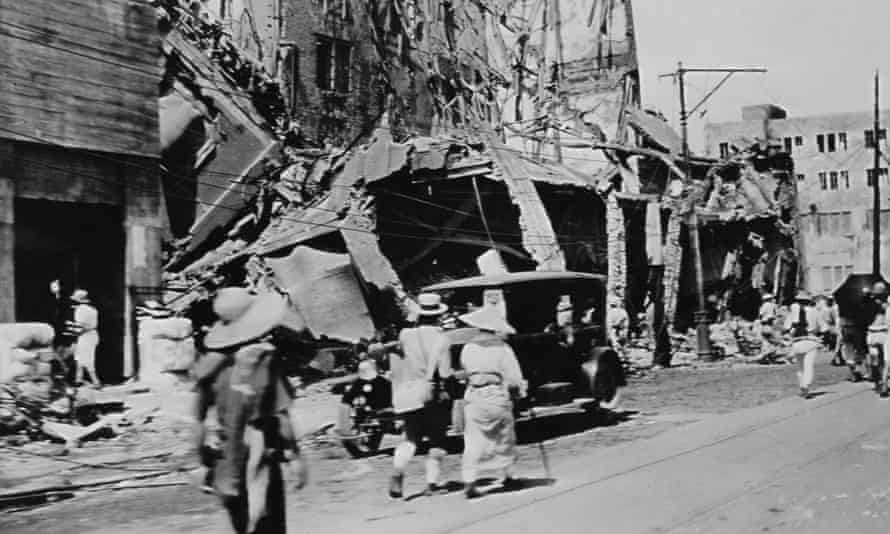
The touch would be devastating. Co-ordinate to an official guess, a magnitude-seven.three quake hit northern Tokyo Bay could impale nine,700 people and hurt virtually 150,000. There would be an expected height of 3.39 million evacuees the day after the disaster, with a farther 5.2 million stranded, while more than 300,000 buildings could be destroyed by the earthquake itself or the ensuing fires.
It would exist the most calamitous upshot to face Tokyo since the US firebombing of March 1945 that killed 100,000 people and burned down more than 267,000 buildings.
Q&A What is Guardian Tokyo week?
Show
As Japan's capital enters a twelvemonth in the spotlight, from the Rugby Globe up to the 2020 Olympics, Guardian Cities is spending a calendar week reporting live from the largest megacity on Earth. Despite being the world'south riskiest place – with 37 million people vulnerable to tsunami, flooding and due a potentially catastrophic convulsion – it is also 1 of the virtually resilient, both in its hi-tech pattern and its businesslike social structure. Using manga, photography, picture and a grouping of salarimen rappers, we'll hear from the locals how they feel most their famously impenetrable city finally embracing its global crown
When the magnitude-7.9 Great Kanto earthquake struck below Oshima Island, nigh 62 miles (100km) due south of central Tokyo, around lunchtime on i September 1923, thousands of buildings collapsed. Fires broke out in homes as cooking stoves overturned, and people who escaped described the aftermath as hell on globe. The combined death and injury cost was officially estimated at 105,000 across Tokyo and the next port metropolis of Yokohama, although some reports said it was far higher.
In the chaotic aftermath of the disaster, faux rumours about a "Korean revolt" and the declared poisoning of wells likewise triggered outbreaks of deadly mob violence against Koreans.
Tokyo has come a long manner since 1923. If whatever urban center is prepared for an earthquake, information technology is this one. The hullo-tech skyscrapers are designed to sway, the parks feature hidden emergency toilets and benches that turn into cooking stoves, and the metropolis has the earth's largest burn down brigade, specifically trained to preclude the kind of flash blazes that spread after earthquakes.
Merely the problem with earthquakes is that they undermine the very things you do to mitigate them. And with Tokyo now seeing millions of tourists a year, and expecting millions more than for the Rugby World Loving cup this twelvemonth and the Olympics in 2020, the city is ripe for panic in the event of a disaster.
"Japan is globe famous for its resilient infrastructure and for its seismic technologies. If y'all expect effectually the Tokyo skyscrapers information technology's incredible how avant-garde a lot of engineering science here is, especially seismic resistance – merely my business concern is preparedness at the customs and individual level," says Robin Takashi Lewis, a Tokyo-based specialist in disaster preparedness and response.
"In the event of a large earthquake hither … there would be significant damage to critical infrastructure such as electricity, gas, water," Lewis says. After a major quake, the Tokyo metropolitan authorities says information technology aims to restore power within a week, water supply in a month and gas within two months. "When you accept a urban center this large and your basic lifelines are out, that's a very significant problem."
Yep, Tokyo has the largest urban firefighting forcefulness in the world. "But in the example of the 'big 1', the Tokyo inland earthquake, the emergency services would be overwhelmed."

Tokyo householders are urged to secure furniture to the wall using Fifty-shaped brackets, and identify wedges under unstable cabinets and anti-skid pads to chair and tabular array legs. Tokyoites are also advised to always shop extra canned food and bottled water, too emergency kits with flashlights, a radio, batteries and everyday medications. Shops sell "emergency toilet numberless" that can exist attached to a standard household toilet when the water supply is cut off. They are well-drilled to take shelter under tables or to concord cushions or pillows over their heads, to ward off falling objects.
Millions of people, notwithstanding, could be travelling on Tokyo's railway and subway network when the quake hits. The Tokyo Metro says its infrastructure has been seismically reinforced, and that trains will brand an immediate emergency finish in potent shaking; it advises passengers to hold tightly to handrails and straps.

Preparing for '10' Day
If that all sounds worryingly matter-of-fact, information technology might be because Japan is uniquely prone to disasters. Earthquakes, tsunamis and typhoons ravage it regularly. The most powerful earthquake e'er recorded in Japan, the magnitude-9 disaster off the due north-east coast in March 2011, shifted the earth's centrality by up to 25cm and moved the land'due south main island, Honshu, 2.4 metres closer to the United States. About 20,000 people lost their lives in the subsequent seismic sea wave, which triggered a meltdown at the Fukushima Dai-ichi power constitute.
Naoshi Hirata, a professor of seismology at the University of Tokyo's Earthquake Research Found, says the urban center is at item risk because two oceanic plates are pushing up against the area – and considering Tokyo lies on the flat Kanto Plain, a geological formation that is easily shaken.
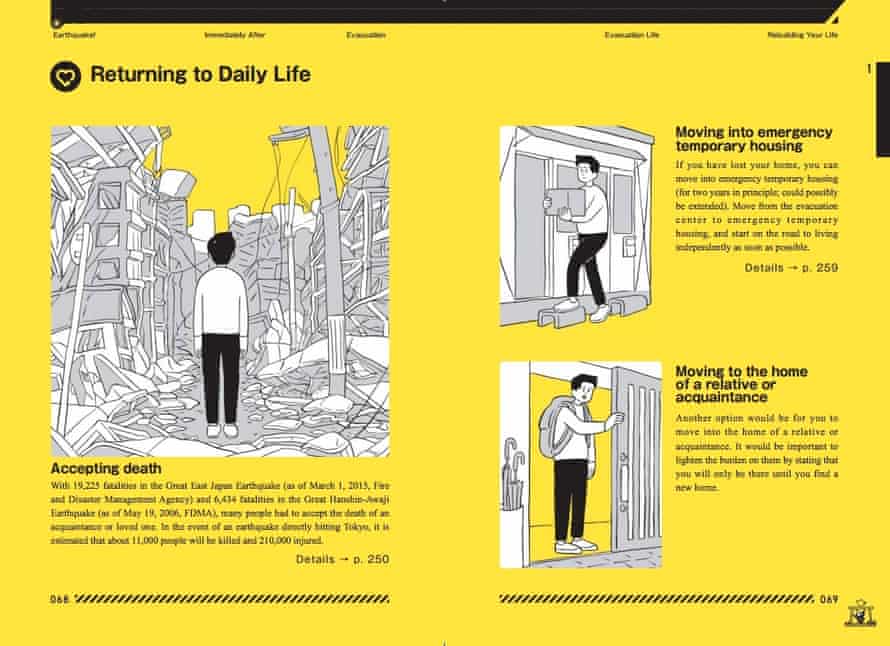
The Japanese are used to the concept of natural disasters. Schools and companies commonly agree emergency drills on 1 September, the anniversary of the 1923 quake now known as Disaster Prevention Twenty-four hour period. The Tokyo metropolitan government has published a 338-page transmission, Let's Get Prepared, outlining what people should expect from various disasters, and how to reduce their risk.
Distributed to 7 one thousand thousand households and produced in multiple languages, information technology includes a short manga comic strip chosen Tokyo 'Ten' Day, starring an office worker navigating scenes of destruction: falling objects, batty trains, crashed vehicles, damaged buildings and mobile network outages. The story concludes with the words: "This is not a 'what if' story. In the about time to come, this story is sure to become reality."
The urban center is also working to update and better its infrastructure. Although its international image is one of boundless modern skyscrapers, experts are worried about the city's traditional textile: pockets of close-prepare, wooden houses where burn could spread quickly.
"We nonetheless have near xiii,000 hectares of full-bodied wooden houses, which is nearly vii% of the area of Tokyo prefecture," Nobutada Tominaga, an official from the city'southward urban development agency, told an urban resilience forum in Tokyo last month. One recently completed projection involved the installation of wide pedestrian zones to assistance create fire breaks in the older suburb of Nakanobu.
The city also reserves a network of major roads for fire trucks and rescue vehicles. These roads are marked with the sign of a large bluish catfish, the Namazu – the giant fauna that causes earthquakes in Japanese mythology.
The city has chosen three,000 schools, community centres and other public facilities to operate as evacuation centres in the event of a major disaster, and in that location are about one,200 centres for people who need special care.
Faced with the prospect of 5.ii million stranded people in a major quake, the Tokyo metropolitan government wants to avoid mass movements of workers returning home and advises people to stay where they are at their workplace or school if possible.
Appropriately, business concern operators are used to keep at to the lowest degree three days' worth of drinking water, food, and other necessities and so that their employees take access to adequate supplies in a disaster. The authorities has too designated temporary shelters for those people who have nowhere to get, where similar supplies will exist available.
Meanwhile, more than 50 sites across Tokyo have been designated equally disaster prevention parks. In normal times, they're used for picnics and other leisure activities, and resemble standard parks in every way except for a grid of manholes in a fenced-off surface area. After a disaster, the manhole covers are removed and special seats and privacy tents are placed over them, turning them into emergency toilets. The park benches, meanwhile, can be converted into cooking stoves. Emergency response would be coordinated from the Tokyo Rinkai Disaster Prevention Park, a xiii.ii hectare site to the north-west of Tokyo Bay.
Milk shake-proof buildings
All-time known are Tokyo'south shake-proof buildings. The epicentre of the 2011 quake was about 230 miles (370km) away from Tokyo, but the city nonetheless felt potent, extended shaking, captured in striking footage that showed skyscrapers swaying like trees in a breeze.
While alarming to those inside, these buildings were doing exactly what they were designed to exercise: bend and flex instead of snap.
The national building law standards mean there should exist "footling damage" in a middle-sized convulsion, and that "a building is not to exist susceptible to collapse in the effect of a major earthquake" of the kind that occurs once in hundreds of years, according to a Tokyo Metropolitan government spokesperson.
Skyscrapers are both the about advanced and get the greatest scrutiny. Buildings over threescore metres must undergo advanced structural analysis as part of more stringent blessing processes. Newer skyscrapers in Tokyo feature a range of anti-seismic devices, including large "dampers" to act as a pendulum and counter the earthquake waves, similar shock absorbers. The swaying is aided by rubber pads or fluid-filled bases.
The country has as well learned from past disasters. In the 1995 Kobe earthquake, most of the complanate structures had been built earlier tougher standards were introduced in 1981. Nearly nine in 10 buildings in Tokyo match mod anti-seismic standards, according to a University of Tokyo written report.
The urban center besides rolled out projects to reduce risks from other natural hazards, such as floods and storm surges. These include floodgates and levees to protect the eastern lowlands, and improved river and diversion channels in the primal area. Where Typhoon Kitty in August 1949 acquired a storm surge of three.15 metres and flooded 137,878 houses, Draft Lan, in October 2017, caused a tempest surge of 2.98 metres – yet not a single house was flooded.
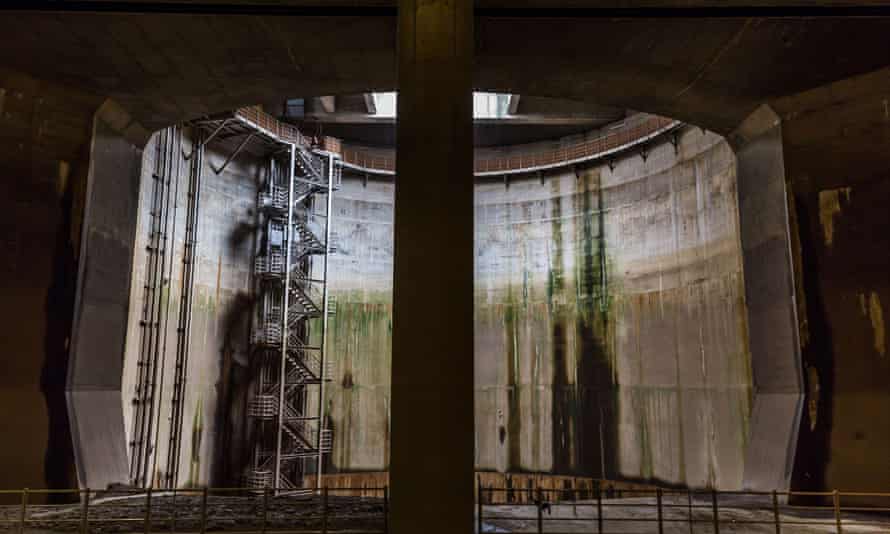
I of the near remarkable infrastructure projects is known as Chiliad-Cans, a 17-year structure project completed in 2009 at a reported price of 230 billion yen (£1.7bn). G-Cans involves a serial of five silos, each 65 metres high, that tin can collect excess water to forbid flooding. These silos connect to a 6.5km-long tunnel that allows h2o to menstruation into a huge underground storage tank. In the particularly rainy Baronial of 2008, when G-Cans was not yet completed, the organization still spared damage to local communities by displacing 11.72m cubic metres of flood water.
An Olympic challenge
While the threat of disasters is not a new miracle for Nihon, the increase in tourism, the steady growth in the number of overseas-born residents, and next twelvemonth's Olympic Games pose new challenges considering visitors may non be enlightened of what to do when a quake hits.
Masa Takaya, a spokesperson for Tokyo 2020, says all venues will comply with Nihon's strict building standards, but organisers are also considering "how we ensure that spectators volition act in a condom fashion if a major earthquake were to occur".
"To assistance deal with whatever emergencies, we are preparing evacuation plans for each venue, and are because the offer of multilingual support to facilitate prompt and smooth evacuation," Takaya says.
The urban center regime has deployed multilingual mobile phone apps to help its growing ranks of international residents understand what to do, and Tokyo municipalities take started inviting foreign-built-in residents to attend hands-on grooming.
Lewis, the disaster preparedness specialist, says that "given the size and the complexity of this metropolis, the government is doing a good job of preparing its citizens" for a big quake. But in that location are notwithstanding "gaps and challenges".
"There hasn't been a big earthquake hither for several years, and the general level of preparedness at a household level could be higher," he says.
A lot will come down to the magnitude of the quake and exactly where information technology strikes. And no matter how prepared Tokyo thinks it might be, information technology is difficult to formally programme for chaos. Later the huge earthquake that struck modern, supposedly quake-proof Kobe in 1995, killing 6,434 people and destroying nearly 400,000 buildings – including the elevated Hanshin Expressway, which collapsed – virtually four in five people requiring rescue were helped past other members of the public rather than the city's official disaster responders.
When X Twenty-four hour period finally arrives, it may be the people of Tokyo themselves who volition be called upon to save their own city.
Guardian Cities is alive in Tokyo for a special week of in-depth reporting. Share your experiences of the urban center in the comments below, on Twitter, Facebook and Instagram using #GuardianTokyo, or via email to cities@theguardian.com
Source: https://www.theguardian.com/cities/2019/jun/12/this-is-not-a-what-if-story-tokyo-braces-for-the-earthquake-of-a-century
0 Response to "What geologic hazard poses a significant threat to Tokyo?"
Post a Comment